Znuny Multi-Instance Development Environment

A comprehensive Docker-based development environment for Znuny that enables working on multiple Znuny Framework instances simultaneously, each with its own database and configuration.
| Repository | GitHub |
|---|---|
| Release |  |
| Issues |   |
| PRs |   |
| Languages |   |
| Code size |   |
| License |  |
| Versions | Status |
|---|---|
 |     |
🚀 Features
- Multi-Instance Support: Run multiple Znuny framework instances in parallel
- Dynamic Framework Creation: Automatically create new framework instances
- Multi-Database Support: MySQL, PostgreSQL, MariaDB per instance (choose one per instance)
- Automatic Port Assignment: Dynamic port allocation (default: 10000, 10001, 10002, etc.; configurable via
BASE_PORT) - Individual Configuration: Each instance has its own environment file
- Dynamic Docker Compose: Automatic generation of docker-compose.yml
- Complete Isolation: Separate volumes and containers for each instance
- Live-Linking: Module-Tools for live synchronization between framework, packages (
/opt/packages/), and developer tools (/opt/tools/) - Developer Tools: Fred for debugging, ZnunyCodePolicy for code quality
- Environment Variables Management: Template-based configuration with automatic backup system
- Bash Scripts: Cross-platform compatibility
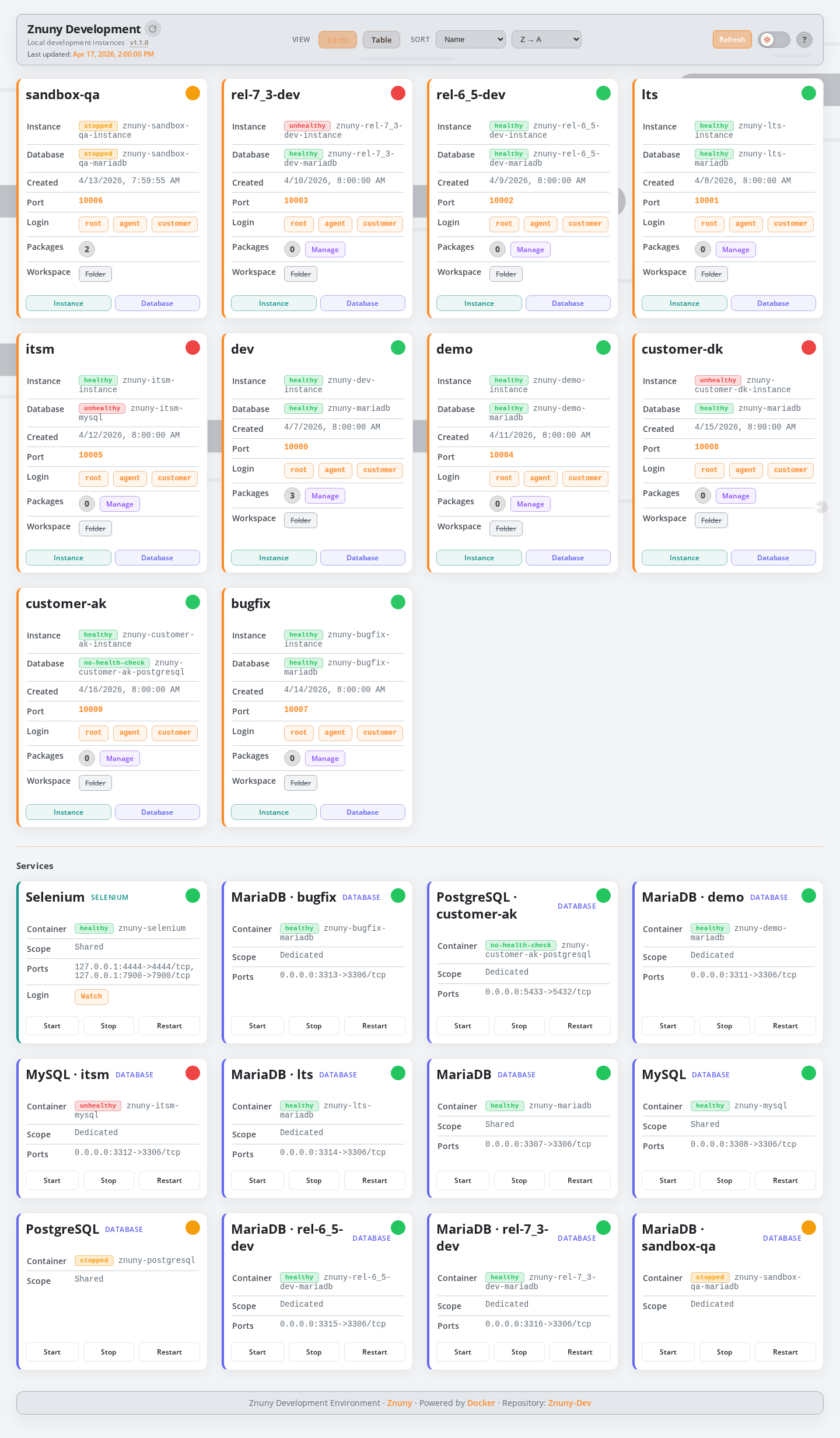
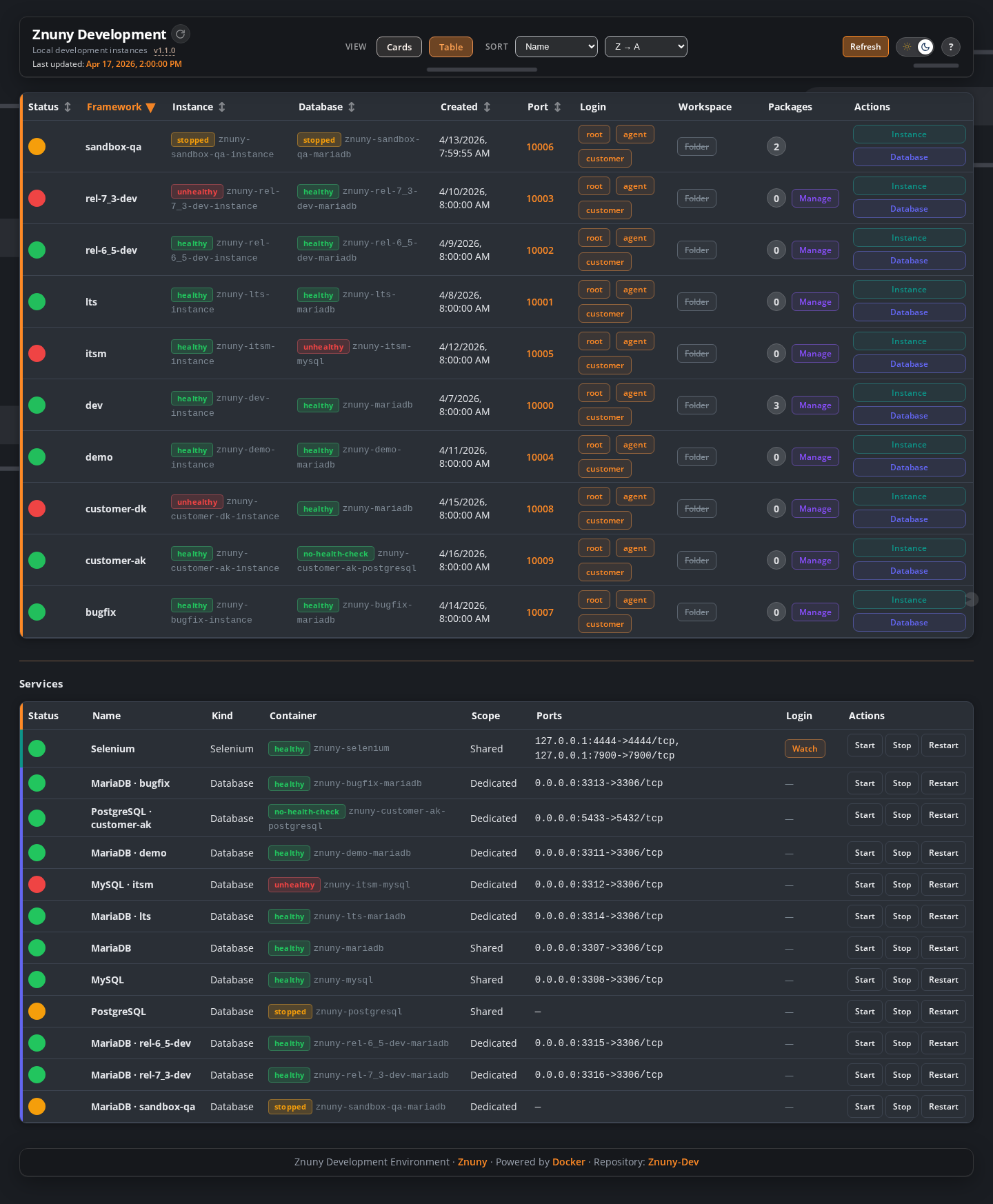
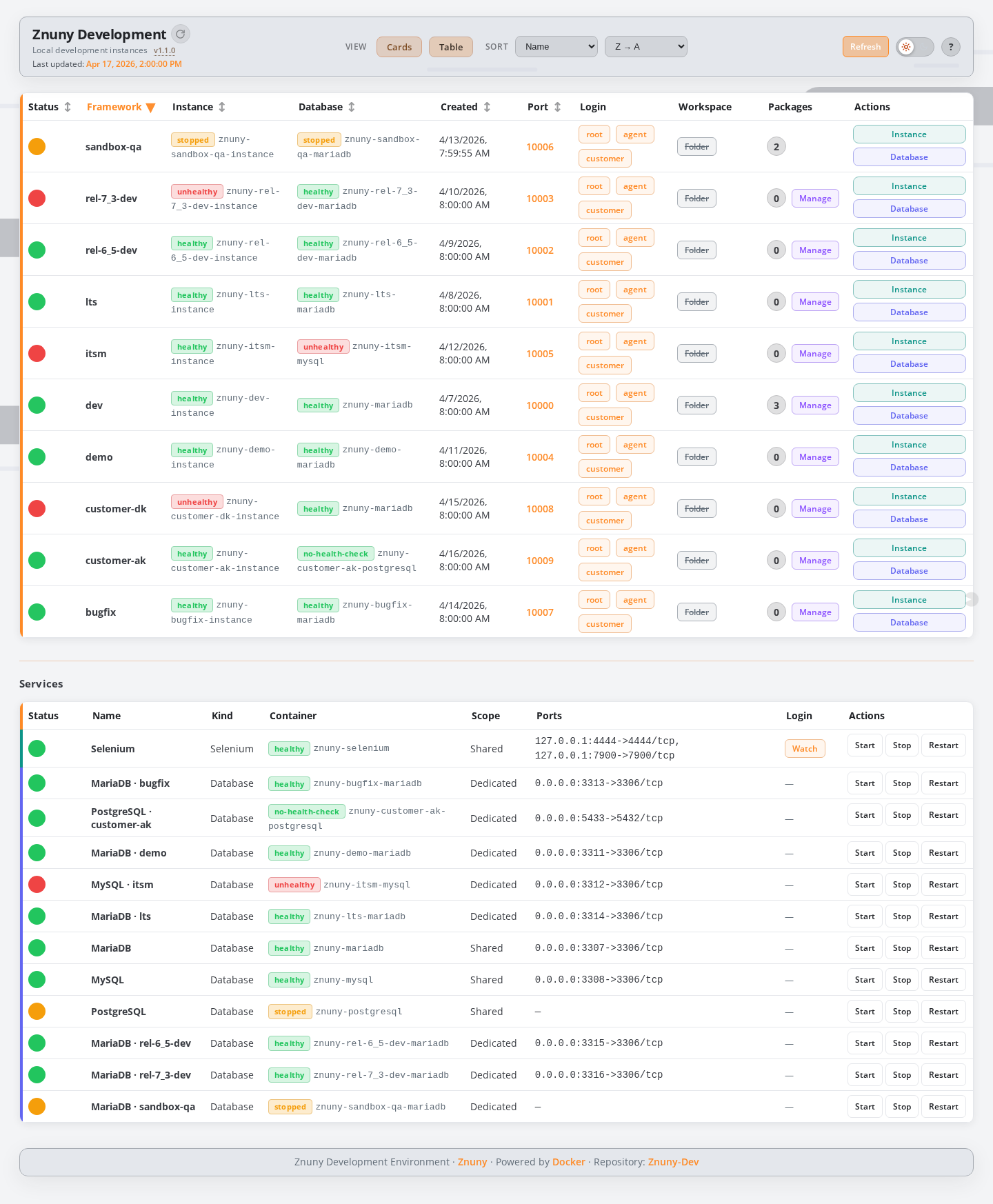
- Optional local dashboard: instance overview at
http://127.0.0.1:9999/— see docs/dashboard.md

More dashboard shots in docs/images/: cards, light, table, dark, table, light. The animated preview is dashboard.gif.
📋 Prerequisites
- Docker and Docker Compose — see docs/setup.md (macOS, Windows/WSL 2, Linux)
- Git
- Bash (available on all platforms)
Optional:
- Node.js on the host — only for dashboard Folder / IDE buttons. The dashboard works without it. The UI runs Node.js 22 inside Docker.
🛠️ Installation
Full step-by-step guide: docs/setup.md — read it completely before running setup.
Quick start:
1
2
3
4
5
6
7
git clone https://github.com/dennykorsukewitz/Znuny-Dev/ znuny-dev
cd znuny-dev

chmod -R +x dev/scripts
chmod +x znuny-dev.sh

./znuny-dev.sh setup-all

Full walkthrough: docs/setup.md
🎯 Usage
All operations go through zd. Run from the project root; if the alias is missing, use ./znuny-dev.sh. Full reference: docs/usage.md (zd help / zd examples stay authoritative).
Everyday commands
1
2
3
4
5
6
7
8
9
10
11
zd status
zd create <framework>
zd start <framework>
zd stop <framework>
zd restart <framework>
zd shell <framework>
zd console <framework> Maint::Cache::Delete
zd log <framework>
zd link <framework> <package>
zd link-fred <framework>
zd dashboard start
Typical flow after install:
1
2
3
4
5
./znuny-dev.sh setup-all
zd create dev
zd start dev
zd status
zd dashboard start   # optional — http://127.0.0.1:9999/
More commands (setup, Module-Tools install/uninstall, CodePolicy, tests, release): docs/usage.md. Dashboard details: docs/dashboard.md.

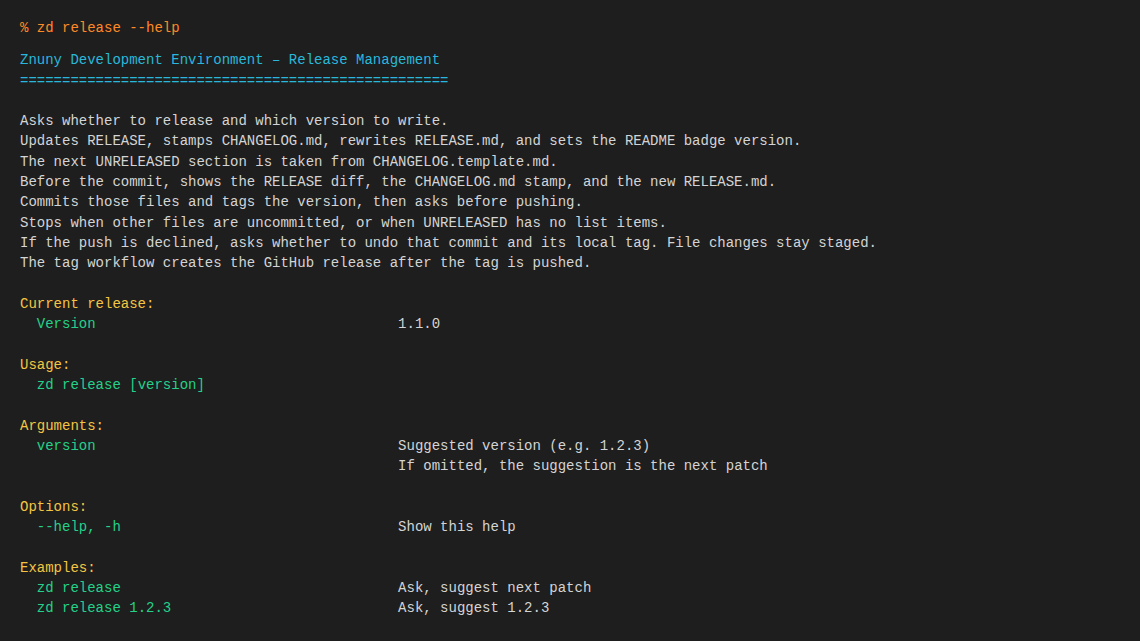
Also in docs/images/: zd status, zd release –help.

Local dashboard
Start with zd dashboard start, then open http://127.0.0.1:9999/. Card and table views, Docker health, start/stop/restart, workspace and IDE links — see the preview under Features.
⚙️ Configuration
Project configs (configs/)
Optional host-side configuration lives in the configs/ directory at the project root. These files override or extend defaults and are not overwritten by setup.
| Path | Purpose |
|---|---|
configs/instance/my.env | Loaded after the global .env; overrides variables (e.g. BASE_PORT, repository URLs like REPO_SOURCE_ZNUNY, REPO_SOURCE_FRED, REPO_SOURCE_MODULE_TOOLS, REPO_SOURCE_CODE_POLICY). |
configs/framework/Config.pm | Optional Perl snippet injected into each instance’s Kernel/Config.pm on container start. |
Load order: Global .env is loaded first, then configs/instance/my.env, so values in my.env take precedence.
configs/framework/Config.pm: Only add valid $Self->{...} = ...; lines (as in Kernel/Config/Defaults.pm). The content is inserted between the markers # insert your own config settings "here" and # end of your own config options!!! in the framework’s Kernel/Config.pm. Changes apply on the next container start (or when the startup script runs the config injection).
🚨 Important Notes
- Template-based .env: Global
.envgenerated from templates, each instance has its own configuration - Automatic generation: docker-compose.yml is automatically updated when changes occur
- Port conflicts: The system automatically assigns free ports for each instance (see instance
.env) - Volumes: Each instance has separate Docker volumes for data and logs
- Isolation: Complete separation between instances
- Apache: CGI mode by default (
ZNUNY_USE_MOD_PERL=falsein instance.env). Znuny’sapache2-httpd.include.confis used, butmod_perlstays disabled so each request runs fresh Perl (stable aftergit checkout). SetZNUNY_USE_MOD_PERL=trueonly if you explicitly want mod_perl.
📁 Directory Structure
1
2
3
4
5
6
7
8
9
10
11
12
13
14
15
16
17
18
19
20
21
22
23
24
25
26
27
28
29
30
31
32
33
34
35
36
37
38
39
40
41
42
43
44
45
46
47
48
49
50
51
52
53
54
55
56
57
58
59
60
61
62
63
64
65
Znuny-Dev/
├── znuny-dev.sh                          # Main script
├── .env                                  # Global config (from dev/templates/env/)
├── RELEASE                               # Version and build information
├── docs/                                 # Extra documentation
│   ├── images/                           # README previews and extra CLI / dashboard shots
│   ├── setup.md                          # Installation & setup (step-by-step)
│   ├── usage.md                          # Full zd command reference
│   └── dashboard.md                      # Local dashboard
├── configs/                              # Optional host overrides (see Configuration)
│   ├── instance/my.env                   # Overrides global .env
│   └── framework/Config.pm               # Snippet injected into Kernel/Config.pm
├── instances/                            # Instance configs (same level as dev/)
│   ├── my_instance/                      # Per-instance: .env, compose, logs/
│   │   ├── my_instance.env
│   │   ├── compose-<framework_slug>.yml  # Auto-generated
│   │   └── logs/
│   ├── dev/
│   └── test/
├── dev/                                  # Development configuration
│   ├── dashboard/                        # Local web UI (zd dashboard)
│   │   ├── public/                       # HTML, CSS, JS (repo mount)
│   │   ├── server.mjs                    # API server
│   │   └── Dockerfile                    # Dashboard container image
│   ├── docker/                           # Docker configuration
│   │   ├── compose-dashboard.yml         # Dashboard compose stack
│   │   ├── compose/                      # Optional extra compose snippets
│   │   ├── Dockerfile                    # Instance image definition
│   │   ├── startup-instance.sh           # Instance startup script
│   │   └── configs/                      # Database configurations
│   ├── templates/                        # Templates
│   │   └── env/                          # Environment templates
│   │       ├── global.env.template       # Global .env template
│   │       ├── instance.env.template
│   │       └── docker.env.template
│   ├── scripts/                          # Management scripts
│   │   ├── common.sh                     # Common functions and utilities
│   │   ├── dashboard.sh                  # zd dashboard commands
│   │   ├── env.sh                        # Environment management
│   │   ├── repository.sh                 # Repository operations
│   │   ├── release.sh                    # Version & release management
│   │   ├── version.sh                    # zd version / update check
│   │   ├── instance.sh                   # Framework & instance CRUD + Lifecycle
│   │   └── instance/                     # Instance-specific modules
│   │       ├── compose.sh                # Compose generation & execution
│   │       ├── network.sh                # Port & network management
│   │       ├── index.sh                  # Framework index allocation
│   │       ├── status.sh                 # zd status (text + JSON)
│   │       └── status-json.sh            # JSON status entry point
│   └── test/                             # Test suite
│       ├── run.sh                        # Run all tests (entry point)
│       ├── tests/                        # Test scripts
│       └── utils/                        # Test utilities (assertions.sh)
├── frameworks/                           # Znuny frameworks (path from .env)
│   ├── my_instance/                      # Custom framework repository
│   ├── dev/                              # Development version
│   ├── test/                             # Test version
│   └── prod/                             # Production version
├── packages/                             # Znuny packages
│   └── [Your packages]
├── tools/                                # Developer tools
│   ├── module-tools/                     # Module tools CLI (not linked into framework)
│   ├── Fred/                             # Fred debugging tool
│   └── ZnunyCodePolicy/                  # Code quality checker
└── README.md                             # This file
🤝 Contributing
See CONTRIBUTING.md for setup, coding guidelines, tests, and the pull request process.
📄 License
This project is licensed under the GNU GENERAL PUBLIC LICENSE Version 3 — see LICENSE.
Happy developing with Znuny! 🎉
This multi-instance system provides maximum flexibility for development with different Znuny versions and configurations simultaneously.